 Chapter 07 · part 2 · 2022–2026
Lendio
SVP of Product
Fintech · 300 employees · $100M in annual revenue
Now the largest online marketplace for small business loans. The company had grown to 300 people and $100 million in annual revenue.
Recruited for a second time to lead the product team and create new product lines, with 40 direct and indirect reports across directors, PMs, and UX designers.
- $9Bin capital attracted (Forward Flow)
- $20Mannual loans, Lender SaaS
- $18Mannual loans, Embedded lending

Bring on the banks
The charter: a lender SaaS product that could attract banks and automate their underwriting.
Up to then the marketplace offered only sub-prime financing through fintech and alternative lenders. But many of the owners who came to Lendio were prime-qualified. Banks held their deposits, yet generally steered clear of loans under $1 million as too costly and risky to underwrite.
The strategy was to build a lender SaaS product, a tool to help lenders compete in this market. This would drive not only recurring revenue, but also bring bank-quality options to small business owners. This played into the “options” principle that had guided Lendio from the start.
- Small business owners prime-qualified, needing cheaper and larger options.
- Bank lenders wanting small business customers, not trusting full automation.
- Marketplace sellers wanting better products to offer applicants.



These images are AI-generated.
Go from 0 to 1
When the first approach failed, I asked to lead it myself.
I began by managing from a high level. One group was building on an acquired, never-released underwriting tool. It had no roadmap and no release plan, and when the target was missed I stepped in. That effort ended in a total loss (from decisions that pre-dated me) and took about a year to manage out.
I then asked the C-team to let me lead as a front-line leader and pick my own PMs and engineers. I interviewed each of them and told them honestly how hard it would be, a filter in the style of Shackleton, so only people ready for something hard would sign on. We met daily for a month, formed pods, set a beta date, and built for three months.

Although Adam’s likeness has been used, the rest is AI generated.
Three new business lines
Intelligent Lending, Embedded Lending, and Forward Flow.
Intelligent Lending gave banks automated decisioning, a white-labeled application, core-system integration, CRA targeting, and instant offers. We demoed in-house, landed a beta bank, and added a second within a month.
Embedded lending put that application / origination experience inside small business service providers’ logged-in experiences, like Paychex, Lowe’s, and Dun & Bradstreet.
Forward Flow let a capital source say “fund loans that look like this” while Lendio automated origination and closing, earning on acquisition and on loan performance.
- Lender SaaS automated bank origination, $20M in annual loans, sub-prime bank options for the first time.
- Embedded lending small business service providers, $18M in annual loans, increased conversion to Lendio.
- Forward Flow AI decisioning and capital deployment, $9B in capital attracted, ability to craft products with lenders / capital sources.
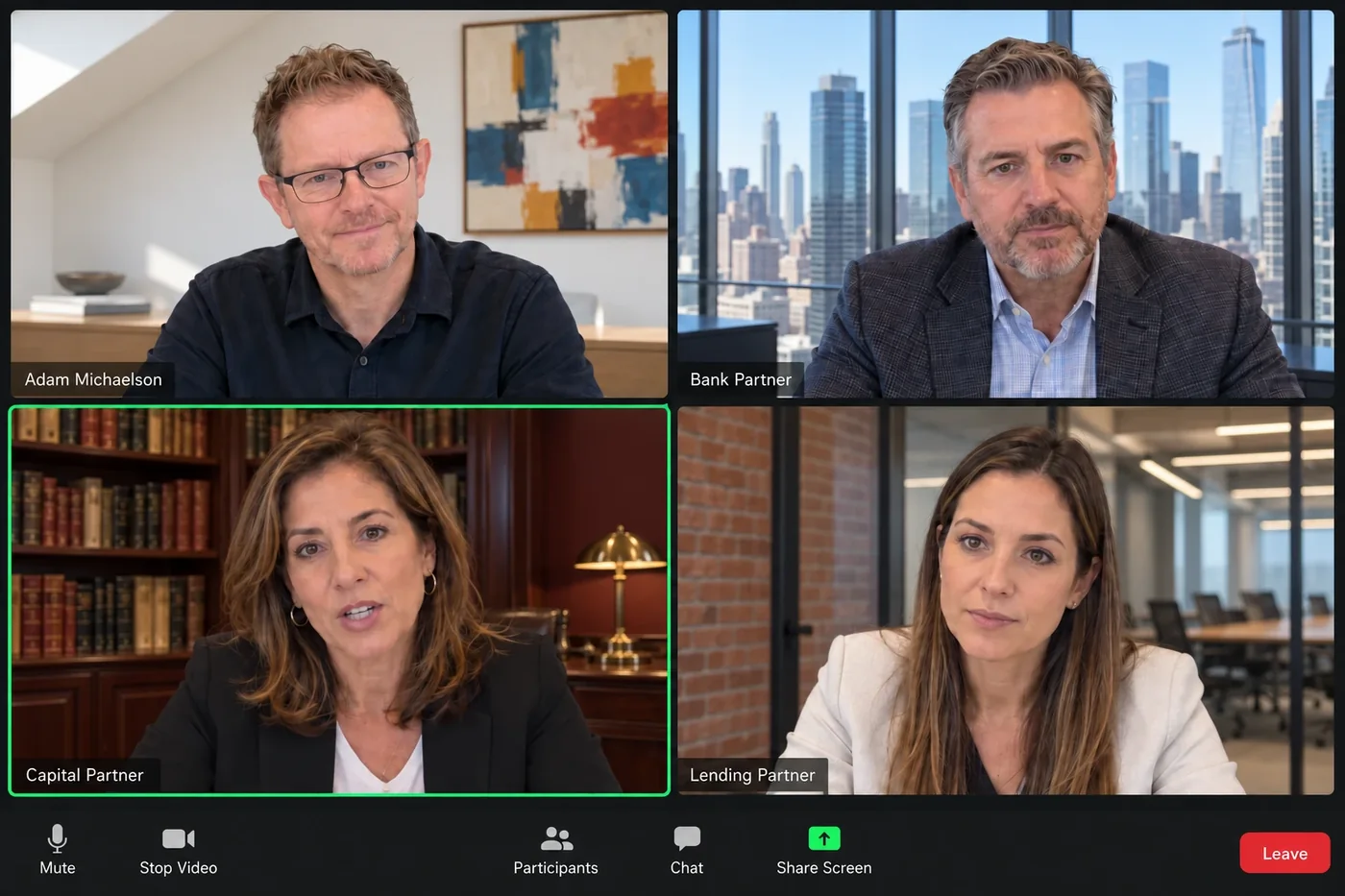
Although Adam’s likeness has been used, the rest is AI generated.
Level up the craft
Instead of letting people go, I made it a challenge to level up.
With 40 people on the team, I could see in the work that some were coasting rather than contributing at a high level. Rather than simply let them go, I brought the whole team a detailed set of expectations, standards, and processes for the craft, and asked if they agreed these defined the job done well. I asked them to calibrate it and add to it, and we landed in full agreement.
Then we trained on it together. I taught and gave assignments, the team helped each other level up, and I met with every person every week to review their outputs and outcomes and give feedback. It was very time consuming, and I did it anyway. The path was clear to everyone from the start:
- At 30 days, anyone not on track for the agreed expectations got guidance from me.
- At 60 days, anyone still not on track was put on a performance plan.
- At 90 days, anyone still not on track was helped to find a better fit elsewhere.
Some who were on board at first suddenly found opportunities elsewhere, and others called it unfair. But those who delivered on the outputs and outcomes loved it, and they have told me it was the biggest leveling up of their careers. The team got about half as large, and far stronger.


Although Adam’s likeness has been used, the rest is AI generated.
Earn trust, then automate
What I learned, how the team adapted, and what came next.
Banks did not trust full automation at first, so we sequenced the strategy: deterministic logic under a lender portal with a clear audit trail of every decision. Then, once trust was earned, full automation and Forward Flow.
In my last month I shipped 12 production features (60,000 lines of code) with Claude Code. I hit the milestones I came to hit, the new product lines and the platform behind them were in place, and the team was strong enough to carry the work forward. I was ready for my next adventure.
Back to the executive bio


Although Adam’s likeness has been used, the rest is AI generated.